
Press Kit








One-liner
Kitiki is a 24/7 TV app for cats built on feline biology instead of bird videos.
Short (listicle blurb)
Kitiki turns the TV into a cat's day: a hunt timed to their mealtime, then calm eat, groom, and sleep phases with music composed for feline hearing. Instead of a 12-hour bird loop that overstimulates and gets ignored within days, it runs a rhythm cats actually follow. Apple TV, Fire TV, Android TV.
Long (news piece)
Kitiki is a smart-TV app that runs a cat's natural daily cycle on screen, 24/7. It's built around the sequence cats follow in the wild — hunt, eat, groom, sleep — adapted for television. The hunt is timed to the cat's real meal schedule, so play ends with an actual catch; the rest of the day is deliberately calm, with ambient visuals and music composed around what cats hear (an octave and a half above us) and easy on human ears too. Hunt scenes are assembled from interchangeable parts so the order stays unpredictable and cats don't habituate the way they do to looping videos. Solo developer Anna Ulanova made Kitiki in Kirkland, Washington, and it's available on Apple TV, Fire TV, and Android TV, with an iPhone/Android companion app for scheduling and a browser demo at play.kitiki.tv.
Fact sheet
| Name | Kitiki |
|---|---|
| What | 24/7 cat TV app built on the hunt–eat–groom–sleep cycle |
| Platforms | Apple TV, Fire TV, Android TV / Google TV; companion app for iOS and Android; web demo at play.kitiki.tv |
| Price | free to try, then a monthly or yearly subscription (pricing varies by region; see the app store listing) |
| Company | Kitiki LLC, Kirkland, WA — solo founder/developer |
| Launched | December 2025 |
| Privacy | no sign-in, no account; anonymous usage analytics only |
| Press contact | anna@kitiki.tv |
Founder story
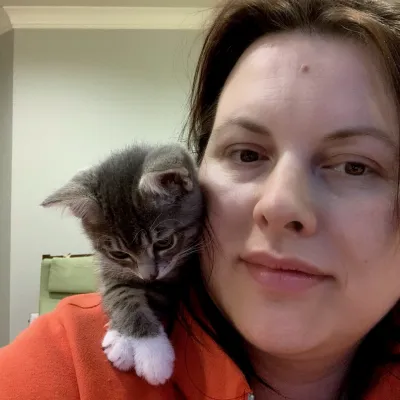
I didn't build this app to start a business. I built it because I was going on a long vacation and was worried that my cats, Karamelka and Kompot, would be bored and under-stimulated in a quiet house.
They had a sitter who came to feed them, play with them, and replenish supplies — but a sitter can't be there 24/7. It was the long, quiet hours between visits that worried me.
I needed a TV channel that wouldn't time out, wouldn't play loud ads, and would follow their natural sleep/wake cycle while I was gone. Nothing existed that could stay "awake" for them 24/7 — so I wrote the code myself.
It kept them calm and settled for two weeks, so I decided to share it with other cat parents who travel.
Science, in three bullets
- Cats habituate to looping video and tune it out; it's change that re-ignites play. Ellis & Wells (2008), Applied Animal Behaviour Science — doi; Hall, Bradshaw & Robinson (2002), Applied Animal Behaviour Science — doi
- A hungry cat hunts harder, and a chase that never ends in a catch is linked to frustration — so the hunt runs before the meal and ends when food appears. Hall & Bradshaw (1998), Applied Animal Behaviour Science — doi; Kogan & Grigg (2021), Animals — doi
- Cats respond to music composed for their hearing and vocal range, not human music — Kitiki's calm-phase music is built on those principles. Snowdon, Teie & Savage (2015), Applied Animal Behaviour Science — doi
- Full list with all eleven sources: kitiki.tv/science