
A calm, ever-changing day for your cat while you're out — an on-screen hunt timed to mealtimes, then a wind-down to rest. It shifts through the day, so your cat stays curious and settles when it's time to sleep.
How Long Can You Leave a Cat Alone?
A healthy adult cat is fine on their own for eight to twelve hours. Past a day, the question changes.
| 8–12 hours | Fine for most healthy adult cats. A working day fits inside this. |
|---|---|
| Up to 24 hours | Occasionally all right, with food, water and a clean tray. Not as a habit. |
| Over 24 hours | Someone needs to come, daily. |
| Kittens | Two to three hours when very young; four to six by six months. |
| Older cats, medication, recent illness | Shorter, and it depends on the cat. |
Worth knowing: none of those numbers comes from a study. PetMD, Hill's and Cats Protection agree closely, and not one of them cites research — there isn't any. The AAHA/AAFP feline life stage guidelines, the profession's own reference, don't cover time alone at all. Take the numbers seriously as clinical experience. Don't treat twenty-four as a line in the sand.
What a daily sitter visit covers — and what it doesn't
A visit covers the things that can't wait: fresh water, a clean tray, food that hasn't spoiled, and — most importantly — someone laying eyes on your cat. Past about a day that stops being optional, and nothing on this page changes it. Three days with a full feeder is three days nobody has looked at your cat.
But do the arithmetic. A sitter's visit is twenty or thirty minutes. Even with someone coming every single day, your cat spends more than twenty-three hours alone. Good advice covers the visit. Almost nobody talks about the rest of it.
Those hours are why we made Kitiki — a TV app that keeps a cat's day running to its usual rhythm when nobody's home to run it.
What goes wrong when a cat is home alone
Rarely loneliness. Mostly the boring things: a tipped water bowl, a tray that stopped being usable on Friday, a jammed feeder. And the serious one — something happening and nobody noticing. A cat can stop eating or develop a urinary blockage, and neither improves on its own.
This is where it's worth being clear about what technology does and doesn't do. A camera tells you something went wrong; Kitiki's phone companion app tells you the day is still running as it should, and what's playing right now. Both are reassurance for you. Neither can open a tin or get anyone to a vet — which is why the visit matters, and why the visit still isn't the whole answer.
Bored, lonely, and whether a second cat helps
Two different problems, and people reach for the wrong fix. Lonely is about you, and you can't solve that from another city. Bored is about a day with nothing in it.
Would another cat help? Somewhat. In a survey of 223 cats, separation-related signs showed up in 30% of single-animal homes against 14.5% of homes with other animals (de Souza Machado et al., 2020). So company does take the edge off. It's still a large, permanent decision made for another animal's sake, and a badly matched pair is worse than one settled cat — you can't referee from a hotel room.
But notice what company doesn't do. Two cats in an empty house are still two cats in an empty house, with nothing happening in it. The gap isn't companionship — it's structure, and that's the part you can actually put back.
Why cats need a routine — and what happens when you leave
You have a routine. Your cat lives inside it — the morning feed, the evening play, settling down afterwards. They've adapted to your day, and it works.
Then you go, and the structure goes with you — not postponed until you're back, just gone.
Cats kept on a deliberately irregular schedule for three weeks — feeding and cleaning at unpredictable times — showed raised stress hormones and changed behaviour. They weren't alone. They weren't neglected. The schedule was simply unreliable, and that was enough. (Carlstead, Brown & Strawn, 1993)
Nicky Trevorrow, a clinical animal behaviourist at Cats Protection, says the same in plainer words: it's the sudden change in routine that brings on separation-related frustration — an owner who was home a lot starting to leave for long stretches. Her first recommendation is a regular routine of feeding, play and rest.
Feeding, play and rest, on a schedule. That's the day Kitiki runs — it's the shape we built it around.
Leaving the TV on for your cat, and why the timing matters
It can help — but not if you only switch it on as you're heading out the door. The less your leaving changes, the better, and a device that appears only at departure changes something.
The instinct is to add things on the way out: a new toy, a gadget, the television for company. Try the opposite.
Cats learn what predicts your departure — the coat, the keys, the bag by the door. Once something reliably means they're going, the thing itself starts producing the reaction. The standard fix is to break the link by doing it without leaving: pick up your keys, put them down, several times a day, until they stop meaning anything (Hill's Pet).
Which means anything you switch on only as you walk out becomes one more departure cue. Set up a device the morning of a trip and you haven't added comfort — you've added a signal.
So start now, on days you're going nowhere. Give it a week or two of being unremarkable. By the time you actually leave, the room hasn't changed.
What Kitiki does with those hours
Something is always playing — the difference is calm or stimulating, and when.
Most of the day is calm, and that's the deliberate part. Gentle scenes with music composed on principles from research into what cats hear and respond to — cats don't process our music the way we do, and this is written for their range rather than ours (Snowdon, Teie & Savage, 2015). It never repeats exactly, so it can't become a loop, but the variation stays below the level a cat notices. It settles into the background the way a familiar room does.
Then, in the half hour before each meal, a hunt. Creatures, movement, a scene built fresh every time — so your cat half-knows it's coming and can never predict what it'll be. That unpredictability is the working part: cats habituate to anything unchanging, and it's change that brings play back (Hall, Bradshaw & Robinson, 2002).
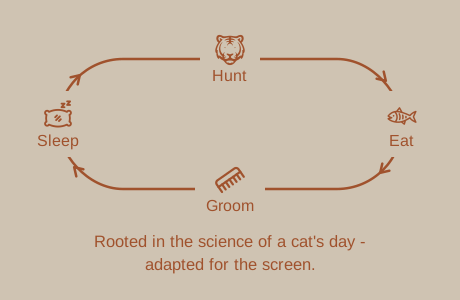
And it's built around your cat's mealtimes, not ours. You've already set the feeder for a certain time. Enter that same time into Kitiki, and the whole day rearranges itself around it — hunt before the meal, wind-down after. The feeder provides the meal. Kitiki gives the hours around it a shape.
Isn't half an hour of screen too much?
The fifteen-to-twenty-minute guidance is about sessions — sustained attention with nothing at the end. This is a window, not a session: cats spend about 6% of their time actually watching a television (Ellis & Wells, 2008). And the real risk in that advice is frustration — chases that never end, the laser-pointer problem (Kogan & Grigg, 2021). This one ends in a meal, every time.
How much cats miss their owners
More than their reputation suggests. Cats form real attachment bonds with the people they live with, on the same secure-and-insecure pattern measured in human infants (Vitale, Behnke & Udell, 2019).
What that means when you leave is much less certain. About 13% of cats in a Brazilian owner survey showed signs their owners linked to being left (de Souza Machado et al., 2020); an earlier study using looser criteria said 19% (Schwartz, 2002). The 2020 authors are refreshingly blunt about their own limits: their criteria were "arbitrarily defined," not one cat had ever been diagnosed by a vet, and the same signs could mean boredom or illness. They call it a neglected area of research.
The attachment is real, then. But anyone who tells you exactly how much your cat suffers when you go is guessing, and what the evidence does support is duller and more useful — cats do badly with unpredictability and well with routine.
How cats behave when you get back
| Normal | Worth a call |
|---|---|
| Following you around, extra affectionate | Not eating or drinking |
| A big meal, then a long sleep | Straining in the tray, or no urine at all |
| Briefly aloof — the classic snub | Hiding and staying hidden |
| Louder than usual for a day | New bald patches from over-grooming |
| One or two tray accidents | Tray problems that carry on for days |
The left column is a cat reasserting a routine. Anything on the right, particularly the urinary signs, is worth a vet the same day.
Can I leave my cat alone for a week?
A week alone is too long — not because a feeder can't hold the food, but because nobody would be looking at your cat. Get a sitter, a friend, a neighbour. Someone who comes daily, scoops the tray, plays with them, and would notice if something were wrong.
Playing with your cat yourself does measurable things no screen can: in one study, daily object play with the owner cut how much cats hunted outdoors (Cecchetti et al., 2021). That's a real behavioural effect from a person with a toy in their hand, and it isn't something an app is going to reproduce.
Kitiki isn't a stand-in for you, or for the sitter. It's for the twenty-three hours in between — the part everyone's advice skips. That's a smaller promise than this category usually makes, and it's one we can keep.
Kitiki runs on Apple TV, Fire TV and Android TV. Tell it when your cat eats, and the day arranges itself around that. More on the research behind it on the science page.
References
Research
Checked against Crossref or PubMed, each with a DOI. Listed alphabetically by first author.
- Carlstead, K., Brown, J.L. & Strawn, W. (1993). Behavioral and physiological correlates of stress in laboratory cats. Applied Animal Behaviour Science 38(2), 143–158. https://doi.org/10.1016/0168-1591(93)90062-T
- Cecchetti, M., Crowley, S.L., Goodwin, C.E.D. & McDonald, R.A. (2021). Provision of high meat content food and object play reduce predation of wild animals by domestic cats Felis catus. Current Biology 31(5), 1107–1111.e5. https://doi.org/10.1016/j.cub.2020.12.044
- de Souza Machado, D., Oliveira, P.M.B., Machado, J.C., Ceballos, M.C. & Sant'Anna, A.C. (2020). Identification of separation-related problems in domestic cats: A questionnaire survey. PLoS ONE 15(4), e0230999. https://doi.org/10.1371/journal.pone.0230999
- Ellis, S.L.H. & Wells, D.L. (2008). The influence of visual stimulation on the behaviour of cats housed in a rescue shelter. Applied Animal Behaviour Science 113(1–3), 166–174. https://doi.org/10.1016/j.applanim.2007.11.002
- Hall, S.L., Bradshaw, J.W.S. & Robinson, I.H. (2002). Object play in adult domestic cats: the roles of habituation and disinhibition. Applied Animal Behaviour Science 79(3), 263–271. https://doi.org/10.1016/S0168-1591(02)00153-3
- Kogan, L.R. & Grigg, E.K. (2021). Laser light pointers for use in companion cat play: association with guardian-reported abnormal repetitive behaviors. Animals 11(8), 2178. https://doi.org/10.3390/ani11082178
- Schwartz, S. (2002). Separation anxiety syndrome in cats: 136 cases (1991–2000). Journal of the American Veterinary Medical Association 220(7), 1028–1033. https://doi.org/10.2460/javma.2002.220.1028
- Snowdon, C.T., Teie, D. & Savage, M. (2015). Cats prefer species-appropriate music. Applied Animal Behaviour Science 166, 106–111. https://doi.org/10.1016/j.applanim.2015.02.012
- Vitale, K.R., Behnke, A.C. & Udell, M.A.R. (2019). Attachment bonds between domestic cats and humans. Current Biology 29(18), R864–R865. https://doi.org/10.1016/j.cub.2019.08.036
Veterinary guidance
These are the sources for the hours at the top of this page. They agree closely with one another — and none of them cites a study, because there isn't one. The AAHA/AAFP guidelines, where you would most expect to find it, don't address time alone at all. Worth a click if you want to check that for yourself.
- American Animal Hospital Association & American Association of Feline Practitioners (2021). AAHA/AAFP Feline Life Stage Guidelines. https://www.aaha.org/resources/2021-aaha-aafp-feline-life-stage-guidelines/
- Cats Protection (2023). How long can you leave a cat alone? https://www.cats.org.uk/cats-blog/how-long-can-you-leave-a-cat-alone
- Hart, H., DVM (2026). How Long Can You Leave a Cat Alone? PetMD. https://www.petmd.com/cat/general-health/how-long-can-you-leave-a-cat-alone
- Shojai, A., CABC (2025). How Long Can You Leave Cats Alone? Hill's Pet Nutrition. https://www.hillspet.com/cat-care/new-pet-parent/leaving-a-cat-home-alone-safely
- Trevorrow, N., Clinical Animal Behaviourist (2022). Does my cat have separation anxiety? Cats Protection. https://www.cats.org.uk/cats-blog/does-my-cat-have-separation-anxiety