
The App That Cat-Sits
When You Can't.
A calm, ever-changing day for your cat while you're out — an on-screen hunt timed to mealtimes, then a wind-down to rest. It shifts through the day, so your cat stays curious and settles when it's time to sleep.
The Science Behind Kitiki
What Kitiki is — and the research behind it. Where a design decision rests on published science, the claim links straight to its source; full references are at the bottom.
Kitiki is a smart-TV app that gives an indoor cat a calm, science-based day, built around the one thing every cat already cares about: mealtimes.
Tell Kitiki when your cat eats, and everything else follows. It plays on the big screen across the room — not a phone — and runs around the clock: no ads, no "Are you still watching?", no screen going dark.
Built around the meal
Enrichment isn't really a pile of objects — a perch, a scratching post, a toy that's ignored by Tuesday. It's a shape to the day. The hard part of leaving your cat home alone isn't the empty room — it's that the day loses its rhythm. The things that give a day its shape (a meal, a play session, a wind-down) usually come with you attached; when you're gone, the hours just run together. Kitiki gives them a shape again.
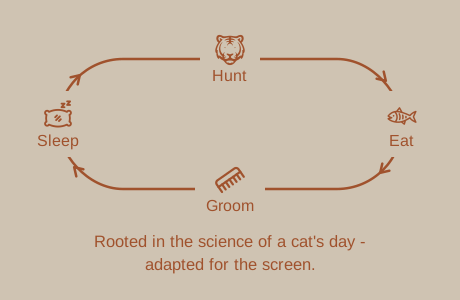
The day follows the cat's natural behavioral cycle — the one behaviorists describe as hunt, catch, kill, eat, groom, sleep. Kitiki runs an adaptation of it, the Hunt-Eat-Groom-Sleep day: a short Hunt that stands in for hunt-catch-kill, then Eat, Groom, and restful Sleep until the next meal.
The meal is the anchor. Kitiki plays the Hunt in the half-hour before mealtime and lets it end in a real catch, just as the food appears. There's evidence behind the timing: a hungry cat hunts harder (Hall & Bradshaw, 1998; Biben, 1979), and a chase that never ends in a catch — the classic problem with laser pointers — is linked to frustration and repetitive behavior (Kogan & Grigg, 2021). It's also why the best time to play with your cat is before a meal, not after. Keeping all of this to a steady daily schedule matters on its own: a predictable routine is one of the most widely recommended ways to lower an indoor cat's stress (Stella et al., 2014; AAFP/ISFM feeding guidelines — Sadek et al., 2018).
A hungry cat hunts harder — so the hunt lands in the half-hour before the meal, and ends in a real catch.
Mostly calm — that's the point
A cat's day is mostly quiet, so Kitiki's is too. For most of the day, it plays gentle scenes and calming music for cats, composed on principles from published research into how cats hear and the sounds they respond to (Snowdon, Teie & Savage, 2015). If you've ever left the TV or radio on so the house isn't silent while you're gone, this is the deliberate version of that instinct — a steady, familiar presence instead of silence, not noise for its own sake. The calm hours aren't filler; for many cats, they're the main event.
The calm hours aren't filler — for many cats, they're the main event.
A hunt that doesn't loop
Most "cat TV" is a video on a loop — cats learn it, get bored, and stop watching (Ellis & Wells, 2008).
Kitiki builds each hunt live from a library of scenes, creatures, and trajectories, recombined each time differently so the cat can't predict what comes next — which creature, from where, or what kind of world it appears in: a forest, a pane of frosted glass, a sunlit riverbed. Familiar parts, unpredictable order. That unpredictability is the mechanism: cats habituate to an unchanging stimulus, and it's change that re-ignites play (Hall, Bradshaw & Robinson, 2002).
Cats habituate to an unchanging stimulus — it's change that re-ignites play.
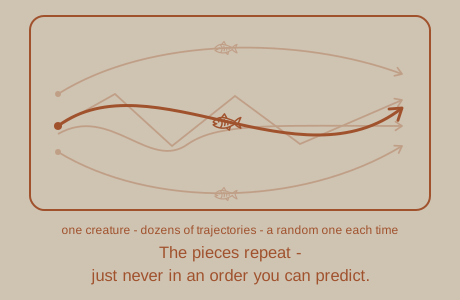
Each creature moves a little differently — its own darting, hesitating, hiding — because it's prey-like movement, more than imagery, that draws a cat to a screen in the first place (Ellis & Wells, 2008).
And it's built around how cats actually see: cats are blue–yellow dichromats (Clark & Clark, 2016; Loop, Millican & Thomas, 1987), so the scenes lean into blues, yellows, and greens, with strong contrast, and skip the reds and oranges a cat can't easily pick out.
It's made to be beautiful to human eyes, too — something you're glad to have glowing in the living room, beyond just functional for the cat. Exciting on purpose, and short on purpose: a burst of instinct before food, not all-day overstimulation.
Check in from anywhere
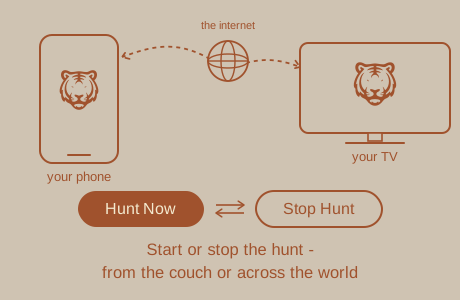
The free Kitiki Companion phone app is your window into the TV and your remote for it: see the current phase and scene, and know it's online and doing its job. If a cat gets too wound up, one tap on Stop Hunt winds the TV straight down into the calm hours — from the couch or from across the world. The TV app runs on Fire TV, Apple TV, and Android TV (Roku coming soon); it's a subscription, with the first week free. The Companion is free on both Android and iOS.
Honest about what it isn't
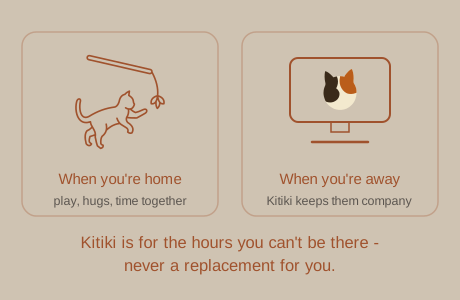
The best thing for your cat is you — a feather wand, a lap, hands-on time, and a treat at the end. Real play beats any device, and nothing substitutes for human-to-cat interaction (Cecchetti et al., 2021); Kitiki doesn't pretend otherwise. It's designed for the hours your cat is home alone while you're at work or out for the day.
How long is too long?
A cat can usually handle a normal workday on its own, but a full day or more calls for a person — a sitter to feed, check in, and play. Even then, no sitter is there around the clock, and it's the long, quiet stretches between visits that Kitiki is built to fill.
None of this means your cat will sit and stare at the screen. A quick look and a wander-off are completely normal — when researchers measured it, cats spent only about 6% of their time looking at a television (Ellis & Wells, 2008). That's the point of the calm hours: a steady presence in the room doesn't need an audience. A glance and a stroll away isn't the app failing — it's exactly what a cat does with a screen.
Cats spend only about 6% of their time looking at a television — a glance and a wander-off is exactly right.
Fast facts
| Product | Kitiki: Interactive Cat TV — a Hunt-Eat-Groom-Sleep day for cats, synced to mealtimes |
|---|---|
| Platforms | Apple TV, Fire TV, Android TV — Roku coming soon |
| Companion | Kitiki Companion (free) — live status and remote Stop Hunt; Android and iOS |
| Pricing | No paywall for the first 24 hours — just open it and watch. After that, a monthly or yearly subscription with a one-week free trial (a subscription because the content is updated regularly) |
| Setup | Enter your cat's meal times — and see the safety page before your first session |
| Company | Kitiki LLC, Kirkland, WA · founded by Anna — an experienced cat mom and indie developer |
| Contact | anna@kitiki.tv · kitiki.tv/feedback |
For happy cats and peaceful homes — start with your cat's meal times.
References
The research below is drawn from Kitiki's scientific grounding review; each citation has been checked against Crossref/PubMed and includes a DOI. Listed alphabetically by first author.
- Biben, M. (1979). Predation and predatory play behaviour of domestic cats. Animal Behaviour 27, 81–94. https://doi.org/10.1016/0003-3472(79)90129-5
- Cecchetti, M., Crowley, S.L., Goodwin, C.E.D. & McDonald, R.A. (2021). Provision of high meat content food and object play reduce predation of wild animals by domestic cats Felis catus. Current Biology 31(5), 1107–1111.e5. https://doi.org/10.1016/j.cub.2020.12.044
- Clark, D.L. & Clark, R.A. (2016). Neutral point testing of color vision in the domestic cat. Experimental Eye Research 153, 23–26. https://doi.org/10.1016/j.exer.2016.10.002
- Ellis, S.L.H. & Wells, D.L. (2008). The influence of visual stimulation on the behaviour of cats housed in a rescue shelter. Applied Animal Behaviour Science 113(1–3), 166–174. https://doi.org/10.1016/j.applanim.2007.11.002
- Hall, S.L. & Bradshaw, J.W.S. (1998). The influence of hunger on object play by adult domestic cats. Applied Animal Behaviour Science 58(1–2), 143–150. https://doi.org/10.1016/S0168-1591(97)00136-6
- Hall, S.L., Bradshaw, J.W.S. & Robinson, I.H. (2002). Object play in adult domestic cats: the roles of habituation and disinhibition. Applied Animal Behaviour Science 79(3), 263–271. https://doi.org/10.1016/S0168-1591(02)00153-3
- Kogan, L.R. & Grigg, E.K. (2021). Laser light pointers for use in companion cat play: association with guardian-reported abnormal repetitive behaviors. Animals 11(8), 2178. https://doi.org/10.3390/ani11082178
- Loop, M.S., Millican, C.L. & Thomas, S.R. (1987). Photopic spectral sensitivity of the cat. The Journal of Physiology 382, 537–553. https://doi.org/10.1113/jphysiol.1987.sp016383
- Sadek, T., Hamper, B., Horwitz, D., Rodan, I., Rowe, E. & Sundahl, E. (2018). Feline feeding programs: addressing behavioural needs to improve feline health and wellbeing. Journal of Feline Medicine and Surgery 20(11), 1049–1055. https://doi.org/10.1177/1098612X18791877
- Snowdon, C.T., Teie, D. & Savage, M. (2015). Cats prefer species-appropriate music. Applied Animal Behaviour Science 166, 106–111. https://doi.org/10.1016/j.applanim.2015.02.012
- Stella, J., Croney, C. & Buffington, T. (2014). Environmental factors that affect the behavior and welfare of domestic cats (Felis silvestris catus) housed in cages. Applied Animal Behaviour Science 160, 94–105. https://doi.org/10.1016/j.applanim.2014.08.006